
Orthopedic Prosthetic Device Market Valuation, ROI Potential & Long-Term Growth Prospects 2026–2036
Orthopedic Prosthetic Device Market
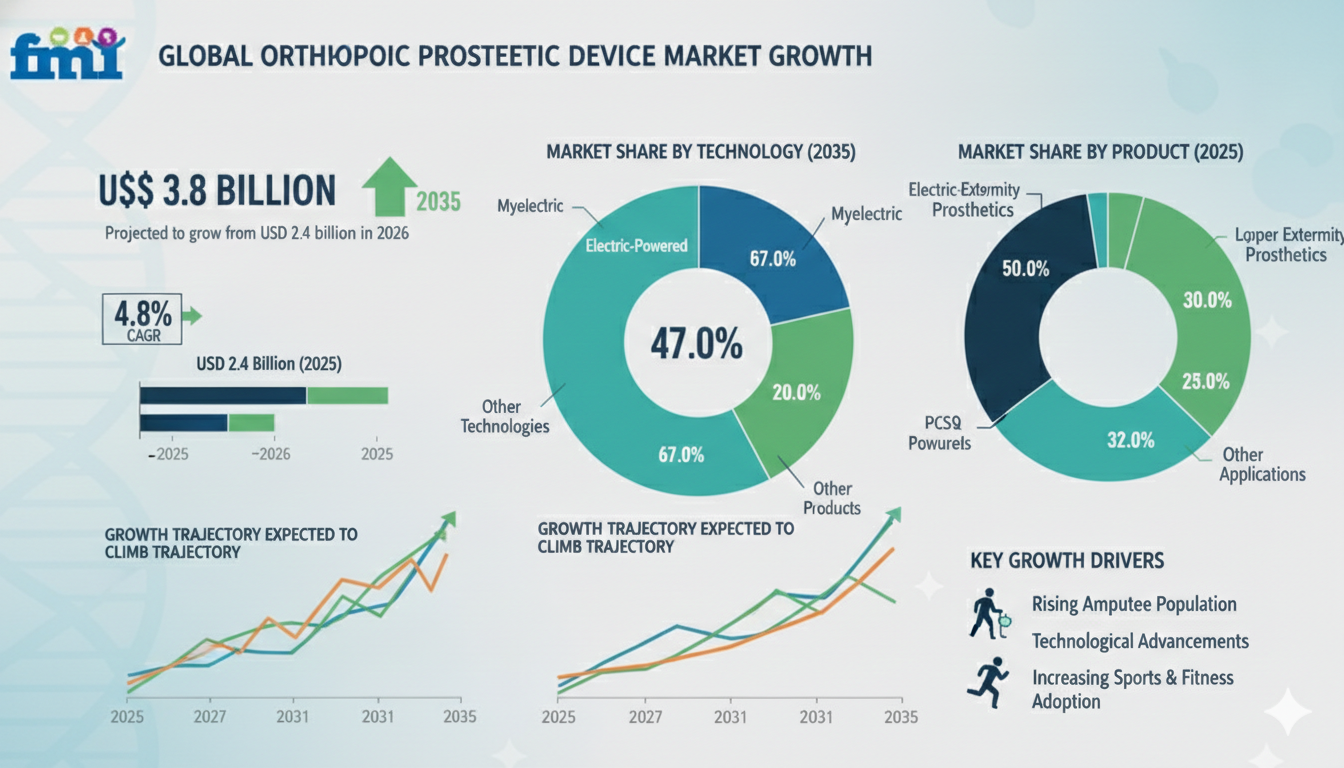
MD, UNITED STATES, January 22, 2026 /EINPresswire.com/ -- Future Market Insights (FMI), a leading market intelligence and consulting firm, today released its latest report on the global orthopedic prosthetic devices market. The comprehensive study projects the market to grow from USD 2.4 billion in 2025 to USD 3.8 billion by 2035, achieving a compound annual growth rate (CAGR) of 4.8%. This expansion represents an absolute dollar opportunity of USD 1.4 billion over the decade, driven by increasing incidences of limb loss due to chronic diseases, accidents, and an aging global population. The report provides detailed insights into market dynamics, segmentation, regional trends, and competitive strategies, offering essential data for stakeholders navigating this evolving sector.
The analysis highlights how technological innovations, such as electric-powered prosthetics with microprocessor controls and IoT integration, are transforming patient outcomes by enhancing mobility and adaptability. Conducted through rigorous data collection and modeling, the report addresses the who, what, when, where, why, and how of market evolution: FMI as the authoritative source delivering projections for 2025-2035 across global regions, motivated by the need for accurate forecasting in healthcare rehabilitation, and executed via in-depth segmentation and trend analysis to support informed decision-making.
Orthopedic Prosthetic Devices Market Overview: Addressing Global Needs for Limb Restoration
The orthopedic prosthetic devices market includes a range of solutions designed for replacing limbs lost to trauma, vascular diseases, diabetes, or congenital conditions. As populations age and chronic illnesses rise, demand for these devices continues to escalate. FMI's report notes that lower extremity prosthetics dominate the landscape, capturing over 50% of the market share in 2025, primarily due to higher amputation rates from diabetes and peripheral arterial diseases. This segment benefits from favorable reimbursement policies in developed regions, underscoring the market's role in improving quality of life for millions worldwide.
By mid-decade, the market is expected to reach USD 3.03 billion by 2030, reflecting steady progress amid healthcare infrastructure improvements in emerging economies. The overall growth trajectory of 1.58 times expansion emphasizes the sector's resilience, even as challenges like high device costs persist. Industry relevance is evident in the integration of prosthetics with broader rehabilitation ecosystems, where hospitals, prosthetic clinics, and rehabilitation centers serve as key end-users.
Key Growth Drivers in the Orthopedic Prosthetic Devices Industry
Several factors propel the orthopedic prosthetic devices market forward, according to FMI's findings. Rising limb loss from road accidents and chronic conditions like diabetes remains a primary driver, with global health data indicating a surge in such cases among aging demographics. Technological advancements play a pivotal role, particularly in electric-powered devices, which hold a 47% market share in 2025. These innovations include smart sensors, 3D-printed components, and energy-efficient designs that enable more natural movement and remote monitoring via tele-orthotics.
Increased investments in healthcare infrastructure, especially in emerging markets, further fuel growth. Public and private initiatives are expanding access to specialized clinics, while awareness campaigns highlight the rehabilitative benefits of prosthetics. Opportunities abound in sustainable materials and AI-enabled customizations, fostering collaborations between manufacturers and healthcare providers to address affordability gaps. FMI's data-backed insights reveal that these drivers could unlock new pathways for market entry, particularly in regions with evolving regulatory frameworks.
Challenges and Opportunities Shaping Orthopedic Prosthetic Market Trends
Despite robust growth prospects, the market faces hurdles such as the high cost of advanced prosthetics, which restricts accessibility in low-income areas, and inconsistent reimbursement policies across countries. The need for skilled professionals in fitting and maintenance also poses barriers, potentially slowing adoption in underserved regions.
However, these challenges present opportunities for innovation. FMI's report identifies potential in 3D printing for personalized devices, hybrid technologies combining conventional and electric systems, and IoT for enhanced functionality. Emerging economies offer fertile ground for local manufacturing and government-backed programs, which could democratize access. By leveraging these trends, stakeholders can mitigate risks and capitalize on the projected USD 1.44 billion absolute growth from 2025 to 2035.
Regional Insights: Orthopedic Prosthetic Devices Market Analysis by Geography
Geographically, the market spans North America, Europe, Asia Pacific, Latin America, and the Middle East & Africa, with varying growth rates reflecting local healthcare dynamics. North America leads with mature infrastructure; the United States anticipates a 3.7% CAGR, supported by strong R&D in myoelectric and robotic prosthetics, while Canada projects 5.2% growth through insurance expansions.
In Europe, Western markets like Germany (5.7% CAGR), Italy (5.3%), and Spain (5.9%) emphasize sustainable materials and digital fitting amid an aging population. The United Kingdom (4.2% CAGR) benefits from NHS initiatives in digital orthopedics.
Request for Sample Report | Customize Report |purchase Full Report -https://www.futuremarketinsights.com/reports/brochure/rep-gb-741
Competitive Landscape: Major Players in Orthopedic Prosthetics
The competitive arena features established leaders like Zimmer Biomet, Össur hf., Stryker Corporation, Blatchford Group, Hanger Inc., Otto Bock HealthCare GmbH, Boston Orthotics & Prosthetics, Arm Dynamics Inc., Steeper Group, and Trulife. These companies are bolstering portfolios with electric-powered and microprocessor-controlled innovations, pursuing mergers, acquisitions, and clinic partnerships for global reach.
Emerging players focus on 3D-printed and hybrid solutions, driving affordability. Recent developments include AI sensor integrations in Canada and Germany, 3D printing expansions in India and Spain, and sustainable material advancements in Europe. FMI's analysis covers over 40 countries, with detailed CAGRs for seven OECD nations, providing a granular view of strategic positioning.
Explore More Related Studies Published by FMI Research:
Infant Heart Monitor Market-https://www.futuremarketinsights.com/reports/infant-heart-monitor-market
Dermal Fillers Market-https://www.futuremarketinsights.com/reports/dermal-fillers-market
Automated Cell Culture Systems Market-https://www.futuremarketinsights.com/reports/automated-cell-culture-systems-market
Auto-Injectors Market-https://www.futuremarketinsights.com/reports/auto-injectors-market
GLP-1 Obesity Home Delivery Injectables Market-https://www.futuremarketinsights.com/reports/glp-1-obesity-home-delivery-injectables-market
About Future Market Insights (FMI)
Future Market Insights, Inc. (FMI) is an ESOMAR-certified, ISO 9001:2015 market research and consulting organization, trusted by Fortune 500 clients and global enterprises. With operations in the U.S., UK, India, and Dubai, FMI provides data-backed insights and strategic intelligence across 30+ industries and 1200 markets worldwide.
Why FMI: Decisions that Change Outcomes- https://www.futuremarketinsights.com/why-fmi
Contact Us:
Future Market Insights Inc.
Christiana Corporate, 200 Continental Drive,
Suite 401, Newark, Delaware – 19713, USA
T: +1-347-918-3531
Website: https://www.futuremarketinsights.com
LinkedIn| Twitter| Blogs | YouTube
Have a specific Requirements and Need Assistant on Report Pricing or Limited Budget please contact us - sales@futuremarketinsights.com
Sudip Saha
Future Market Insights Inc.
+1 347-918-3531
email us here
Legal Disclaimer:
EIN Presswire provides this news content "as is" without warranty of any kind. We do not accept any responsibility or liability for the accuracy, content, images, videos, licenses, completeness, legality, or reliability of the information contained in this article. If you have any complaints or copyright issues related to this article, kindly contact the author above.
